

Is the Law Our Drill Sergeant?
Galatians 3:21–24

"[21] Is the law then contrary to the promises of God?
Certainly not!
For if a law had been given that could give life,
then righteousness would indeed be by the law.
[22] But the Scripture imprisoned everything under sin,
so that the promise by faith in Jesus Christ
might be given to those who believe.
[23] Now before faith came,
we were held captive under the law,
imprisoned until the coming faith would be revealed.
[24] So then, the law was our guardian until Christ came,
in order that we might be justified by faith. "
(ESV)
This is the first part in this series on Galatians 3:24.
The first post is here.
The second post, a short story, is here.
A third post is here.
The Frontline of Moralism

Galatians 3 highlights one of the frontlines in the battle of salvation: are you justified through your actions or by hearing in faith? Paul has provided us with a situation in Galatians 3. In this chapter, we see both law and faith personified in familial roles as it relates to us. Let us take this scenario and see if our understanding of the law aligns with God’s.
From the very beginning of this chapter, tensions are palpable, as reflected in Paul’s words,
"[1] O foolish Galatians! Who has bewitched you? It was before your eyes that Jesus Christ was publicly portrayed as crucified. "(ESV)
- “works” and “hearing” (v2ff)
- and “law” and “faith.” (v2ff)
I am the one who needs salvation; this refers to me and my journey. Paul beckons with these words in Galatians 3:28,
"[28] There is neither Jew nor Greek, there is neither slave nor free, there is no male and female, for you are all one in Christ Jesus." (ESV)
The Law Personified
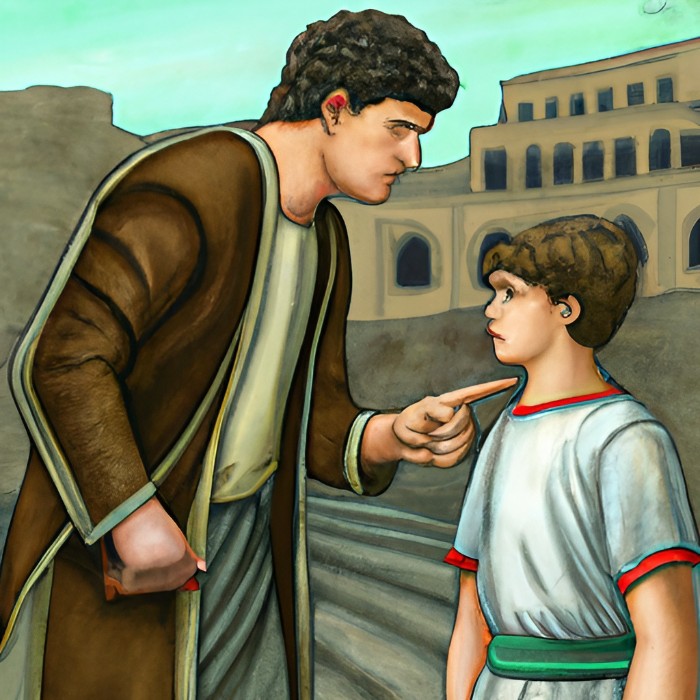
Picture the law as a person in your life. How would he interact with you, and what role does he play? Do you imagine the law, as a person, will protect you? How can he? His strength is not his own. Indeed, this guardian is generally older and of little use elsewhere. This law keeper safeguards the limits; and, when transgressed, administers rightful punishment dictated by justice.
At best, the law can only inform you of your score. The perfect situation would require a flawless tally for the law to take no further action. Jesus received such a tally. This perfection is just one reason He is so amazing.
God implemented the law because we breached the boundaries of creation. Laws are established to guarantee open and honest communication so that enforcement is not arbitrary. The law’s existence is proof that we transgressed the boundaries. We have all broken the law at some point in our lives – we are not exempt from being accountable for transgressions against the Law Giver.
Galatians 3 reveals a context of salvation framed by family roles. In Galatians 3:7, we can better understand how the idea of salvation intertwines with Roman cultural family dynamics. These two ideas interweave biblically. To be saved is to be adopted into the Family of God. This context is no simile or scenario, then. The frontline of this battle for most is its reality.

Read this Scripture as God intends. This role of the law is not make-believe; it is your life. The law has done this to all of us.
"[7] Know then that it is those of faith who are the sons of Abraham." (ESV)
And it goes all the way through Galatians 4:31.
"[31] So, brothers, we are not children of the slave but of the free woman." (ESV)
Our context is being an heir in a distinguished family back in the roman empire in 1 century AD. In being saved, we are not simply given a place in any ordinary family but welcomed into the most prestigious families as beloved heirs.
The Law as Our Guardian
Our epicenter is Galatians 3:24, where the law fills in as guardian to an heir of a distinguished family. The law, we discover, is our guardian. Galatians 3:24 illuminates this reality,

“[24] So then, the law was our guardian…” (ESV)
Whew! That does not sound so bad. Right? Wrong. To understand this guardian’s role with an heir, let us look at the surrounding text. This guardian is extreme, as revealed in our context.
The list provided is not anything less than 1970 SEALs training. Think nightmare Drill Sergeant. Here are things we know about this guardian from Galatians 3:
- He has been assigned to us (v19).
- He was assigned because we broke laws (v19).
- His oversight is instituted until we receive our inheritance (v19).
- His assignment was not of his own making. He was assigned by an intermediary (v19).
- The need for an intermediary to post an attendant means the law broken was against our Father (v20).
- This guardian has no access to the inheritance (v21).
- This guardian is not paternal (v21).
- He has the authority to imprison his charge (v22).
- Only the Father can release the imprisoned heir (v22).
- This guardian enslaves his charges (v23.)
- He is the harsh taskmaster.
The Harsh Taskmaster
Here is something else about this taskmaster. He is enslaved too. His title is the word we translate as guardian – Pedagogue (παιδαγωγος). He is a special kind of teacher who is always with you. When you wake, he is there. As you go along your way, he is there. When you sit, he is there with lessons. When you rise, he posts reminders all around. And he always lives with you for a purpose – to keep you in the confinements of the law. Should you disobey, he is there to punish you. He has no choice. He has been assigned to you. And he will guard you.
This Pedagogue (παιδαγωγος) is distinguished from the Didaskalos (διδάσκαλος, academic tutor). Still, might you want to make this guardian your cuddle bug? Not likely. It was a disdained position. Assigned to the infirmed or despised, such as prisoners of war. A quote from Timothy George in his commentary on Galatians, as cited from Mounce’s article, is most illuminating:

“No doubt there were many pedagogues who were known for their kindness and held in affection by their wards, but the dominant image was that of a harsh disciplinarian who frequently resorted to physical force and corporal punishment as a way of keeping his children in line. For example, a certain pedagogue named Socicrines was described as a “fierce and mean old man” because of his physically breaking up a rowdy party. He then dragged away his young man, Charicles, ‘like the lowest slave’ and delivered the other troublemakers to the jailer with instructions that they should be handed over to ‘the public executioner'” (pp. 265-266).

Take Drill Seargeant and Mr. Manners. Put them together, and you have the ultimate terror for children everywhere. We know something about this guardian; he is a miser who loves the law. He loves the borders. They are precious to him.
Why does Paul explore this guardian’s role? He is showing us how the Covenant of Law is under the umbrella of the Covenant of Faith. Not vice versa. It does this by showing what role the law would be if a person. And to whom is the law relating here? To you. To me. We know this to be the case because the personification of faith is represented. What would faith look like in person? It looks like Jesus. Even more so, Jesus is faith. Every time the Bible references living faith – genuine faith – it is regarding Jesus. Jesus is the living faith.

In our next post, we explore “until Christ came.” But know this, the law in this context – a moralist interpretation of Scripture – can never give you the inheritance of the promise. That only comes by faith. They are different. Do not stumble over the Rock of Offense.
Bill Mounce’s Analysis of παιδαγωγος in Galatians 3:24 is an excellent source for this verse.
Bill Mounce has authored innumerable articles intersecting biblical interpretation with his expertise in koine Greek. As such, his Monday with Mounce is a treasure. You can find his post on Galatians 3:24, “To Metaphor, or not to Metaphor? (Monday with Mounce 61),” here.

I am Iz. I am a follower of Jesus, seeking to understand the world around me. I use my life experiences and struggles as a platform to reach out and help others, offering insight into how faith overcomes any obstacle. I pray my blog will be a beacon of hope for you who face similar challenges. May this be an encouragement to you.
Scripture quotations are from the ESV® Bible (The Holy Bible, English Standard Version®), copyright © 2001 by Crossway, a publishing ministry of Good News Publishers. Used by permission. All rights reserved. The ESV text may not be quoted in any publication made available to the public by a Creative Commons license. The ESV may not be translated into any other language.
Users may not copy or download more than 500 verses of the ESV Bible or more than one half of any book of the ESV Bible.

very nice job.